The Sovereign Professors Thesis of The Two Bloodlines
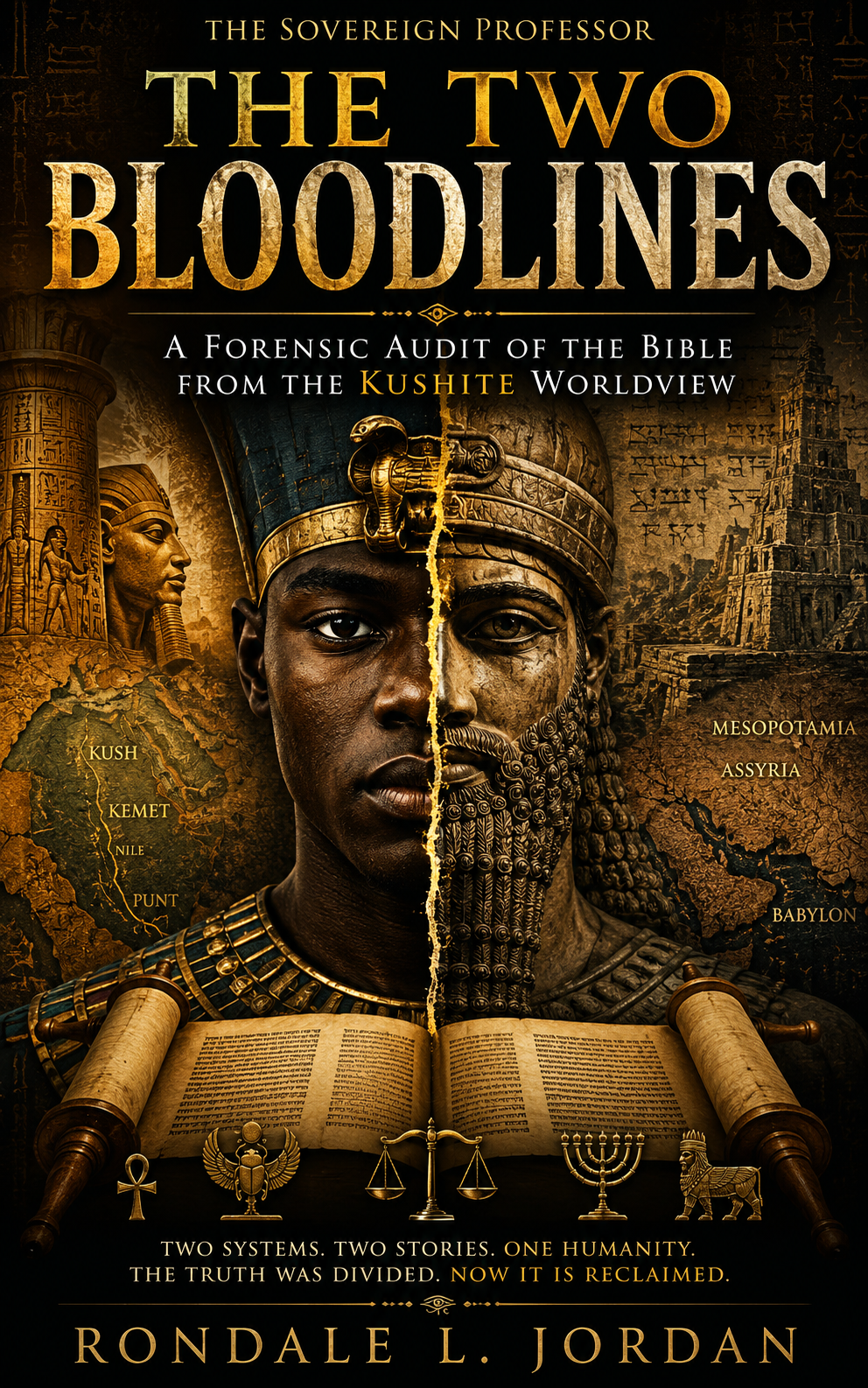
The Sovereign Professors Thesis of: The Two Bloodlines
A Forensic Audit of the Bible from the Kushite Worldview
By Rondale L. Jordan
Click Here To View On Amazon.com
What if the greatest conflict in human history was never merely political, racial, or religious—but biological, geographic, and administrative?
In The Sovereign Professor: The Two Bloodlines, Rondale L. Jordan performs a forensic extraction of the biblical narrative, stripping away centuries of imperial interpretation to reveal the hidden Kushite framework buried beneath mainstream theology.
This is not traditional religion.
This is a sovereign audit of sacred history.
Drawing from geography, genealogy, architecture, language systems, Nile Valley symbolism, and comparative scripture analysis, Jordan reconstructs what he calls the “K-Frequency”—an ancient pattern connecting the civilizations of Kush, Kemet, Mesopotamia, the Levant, and even the mound-building cultures of the Americas.
At the center of this investigation is a controversial thesis:
The biblical narrative preserves an ongoing collision between two operating systems—between administrative power and creative sovereignty, between what was formed for control and what was created in divine image.
Inside this forensic audit, you will uncover:
- The Nile–Mississippi Mirror
A radical exploration of the symbolic and civilizational parallels between the Nile Valley and the mound-building cultures of the Americas. - The Science of Differentiation
Why the distinction between the “Beasts of the Earth” and the “Beasts of the Field” becomes central to understanding domestication, labor systems, and human identity. - The K-Frequency vs. the C-Filter
An investigation into root-language systems, symbolic sound patterns, and the preservation of sovereign identity across civilizations. - The Tower of Babel Reconsidered
A reinterpretation of Genesis 11 as a conflict over unity, language, administration, and centralized power. - The Hagar–Abram Protocol
A forensic analysis of bloodline politics, migration, and the recurring relationship between Mesopotamian patriarchs and Nile Valley populations. - The Architecture of Sacred Space
How the symbolic language of the Nile—columns, rivers, stars, papyrus, and temple geometry—shaped the spiritual architecture of the ancient world.
Jordan challenges readers to move beyond inherited doctrine and examine the text through geography, biology, and observable historical patterns. Whether accepted or contested, this work is designed to provoke investigation, debate, and deeper scrutiny of the foundations of sacred interpretation.
The audit is complete.
The evidence is written in stone.
Class is in session.